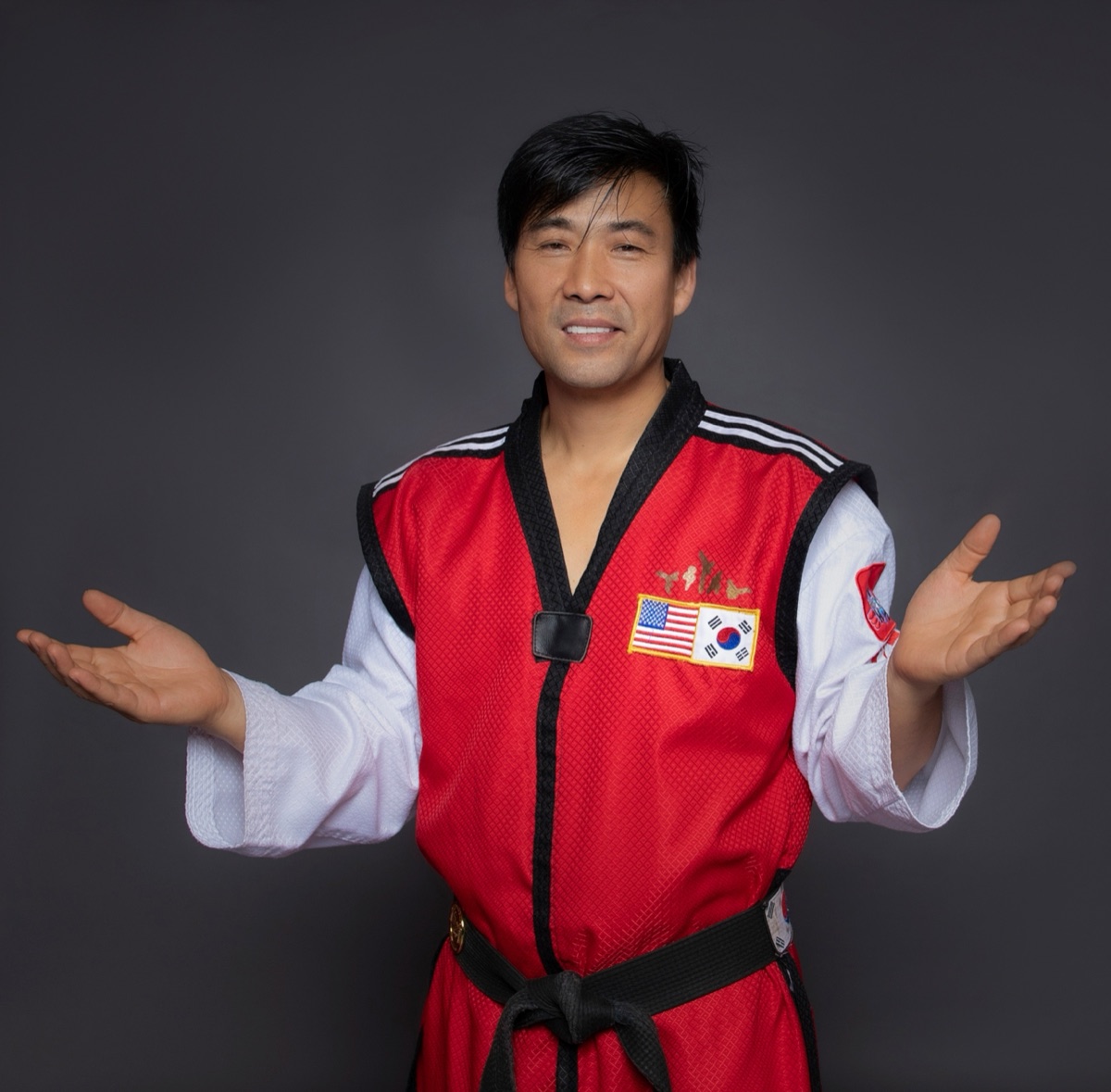
Dear Parents,
Let me share a secret I have learned in thirty-six years of standing on the mat: focus is not something a child is born with. It is something a child is taught — one bow, one breath, one kick at a time. I have met thousands of wonderful kids who "couldn't sit still," who "wouldn't listen," who were, in their parents' loving words, "a little tornado." And I will let you in on something — those are very often my favorite students. Because a tornado has a great deal of energy. Our job is simply to give it a direction.
Parents tell me all the time, with a worried look, "Master Cho, my son just can't concentrate." Then six months later they stop me in the lobby, almost in disbelief, to tell me he stood at attention for the entire class — eyes forward, listening with his whole body. We did not drill the energy out of him. We did something better. We made focus fun, and we built it on a foundation that holds for a lifetime: respect.
And here is good news for the families whose kids did not start at age four: it is never too late. I have watched shy fourteen-year-olds and busy teenagers build focus just as powerfully as the little ones — sometimes faster, because they choose it for themselves. So whether your child is six or sixteen, this is for you. Here are the five ways Taekwondo builds focus — and why I believe respect is the soil all five of them grow in.
Focus Begins With a Bow
Every single class begins the same way: we bow. To the flags. To the instructors. To one another. It takes three seconds — and it changes everything. That little bow is a signal to a child's brain that says, "We are beginning now. The outside world can wait." It is a doorway. On one side is the hallway, the car ride, the argument about screen time. On the other side is the mat, where we are fully here.
This is where focus and respect become the same lesson wearing two uniforms. When a child learns to honor the moment — the teacher speaking, the partner across from them, the space they train in — they are, without even realizing it, learning to pay attention to it. You cannot respect what you are not paying attention to. And you cannot focus on what you do not respect. The bow teaches both at once.
"A child who respects the moment is a child who is paying attention to it."
— Grand Master Cho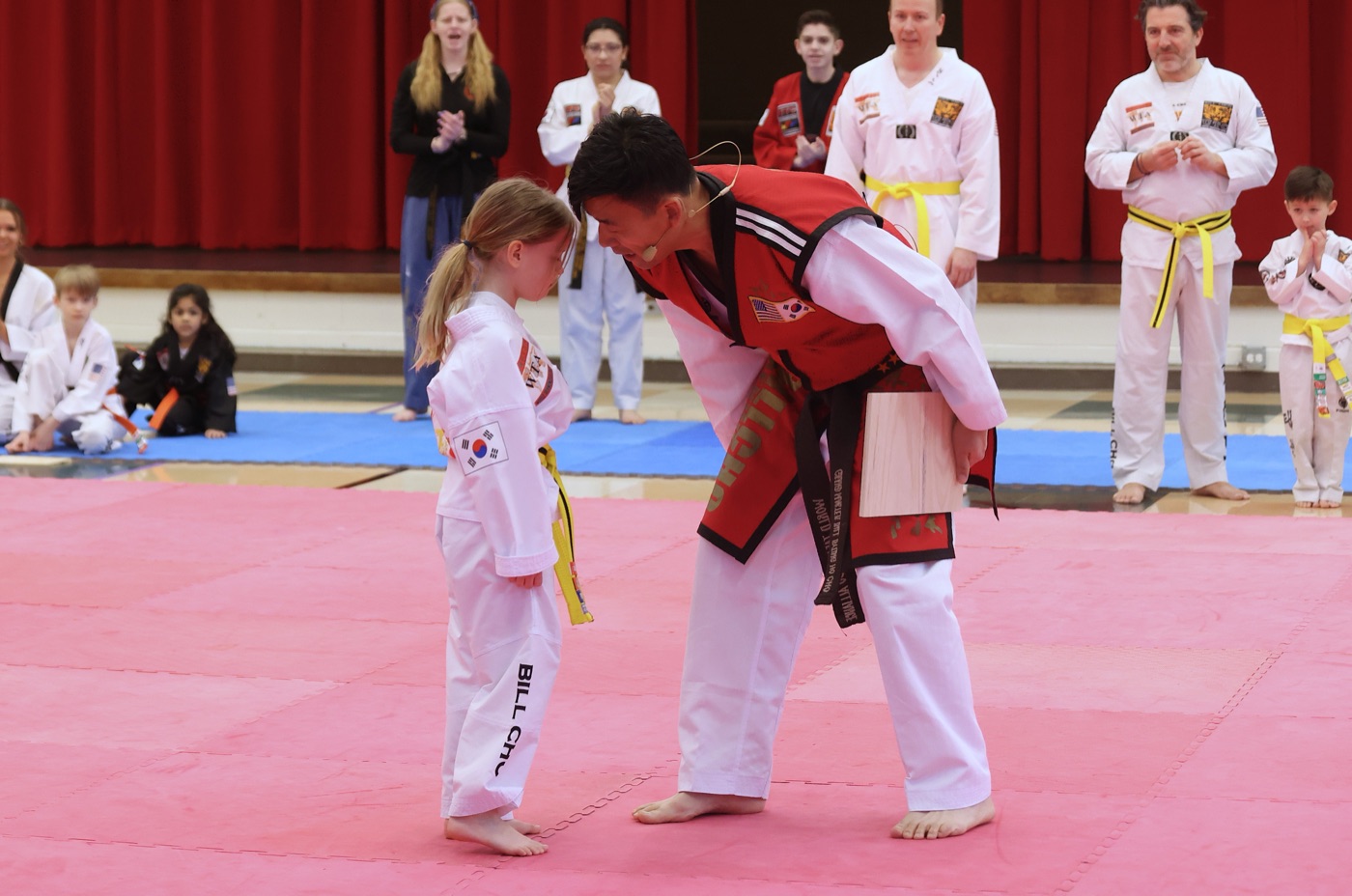
One Kick at a Time, On Purpose
We live in a world that begs your child to do five things at once — a video playing, a game pinging, a chat buzzing. A Taekwondo form, or poomsae, asks for the opposite. It is a memorized sequence of techniques performed in a precise order: block, step, kick, turn. To do it well, a child must hold a single chain of movements in their mind and execute it with their whole body. That is single-tasking, and it is a muscle most kids rarely get to exercise anymore.
Here is the beautiful part: this is brain training disguised as a workout. Memorizing the pattern builds memory. Holding the balance builds patience. Hitting each move on count builds precision. Your child thinks they are just "practicing their form." What they are really practicing is the ability to start something, stay with it, and finish it well — the exact skill that wins at homework, at music, at sports, and one day, at life.
The "One Thing" Minute
Once a day, ask your child to do one small task — set the table, tie their shoes, read a page — with zero distractions and their full attention. Just sixty seconds of one thing, done all the way. It is a form of its own, and it works.
Eyes Up, Ears On
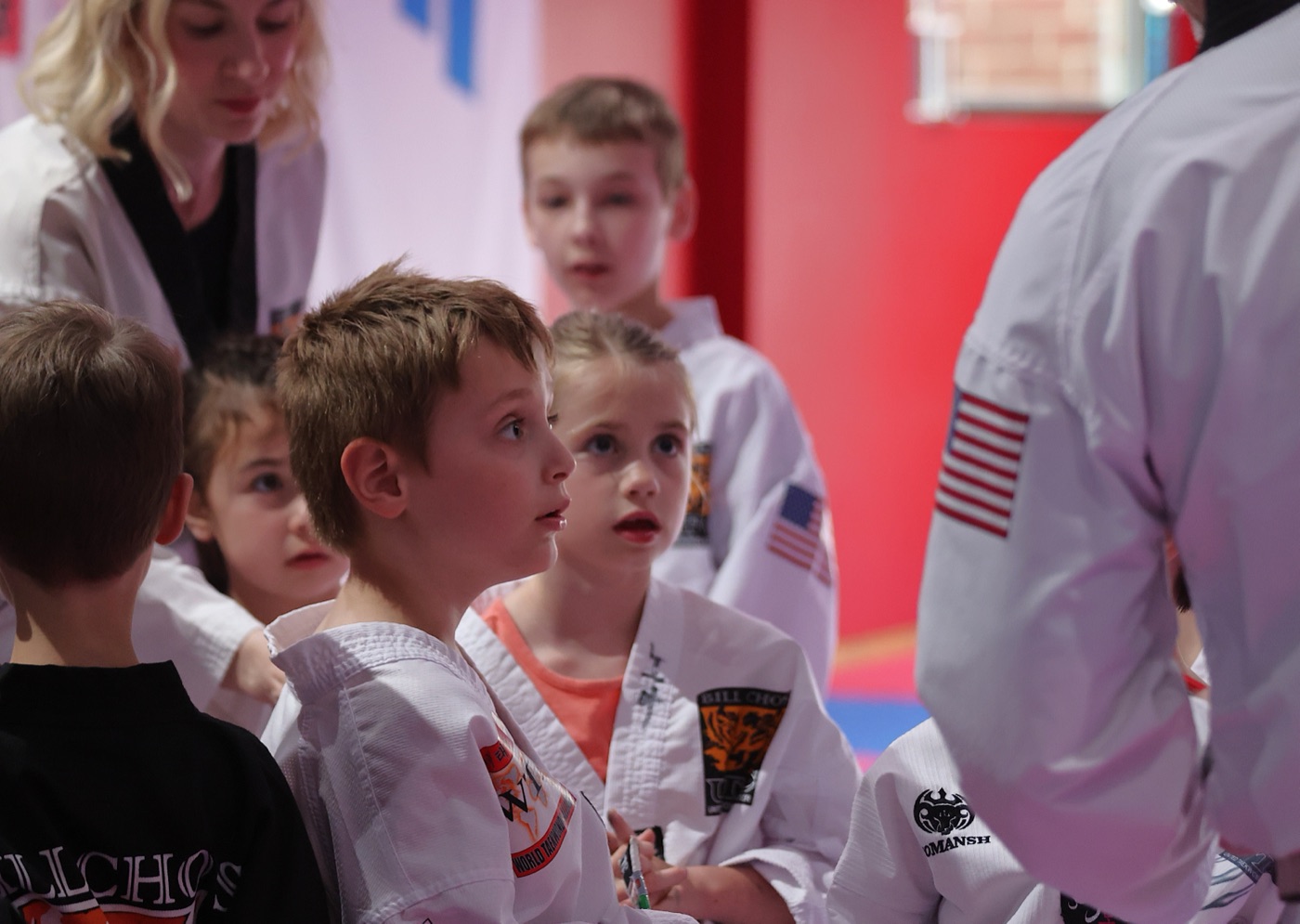
"Yes, sir." "Yes, ma'am." Eye contact when an instructor speaks. A loud, proud "Yes!" before a drill begins. These are not old-fashioned formalities — they are focus, practiced out loud. We teach children to listen with their whole body: still hands, quiet feet, eyes on the speaker. When the body settles, the mind follows. A child who can hold their attention on a Master for forty-five minutes can hold it on a teacher, a coach, or a textbook just as well.
What surprises parents most is how quickly it travels home. The same child who is learning to look their instructor in the eye starts looking you in the eye. The listening they practice on the mat does not stay on the mat. It follows them to the dinner table.
The Belt Is a Long Game
You cannot rush a belt. You cannot download it, buy it, or talk your way into it. Every belt at our school is earned — through weeks and months of showing up, of small daily progress, of one good class stacked on top of another. In a world built on instant everything, this is quietly revolutionary. A belt teaches a child that the best things take time, and that steady beats fast.
This is focus stretched across a calendar. It is the patience to keep working when the reward is still months away — the exact opposite of the quick-hit, swipe-to-the-next-thing rhythm so many kids are growing up inside. And when that belt is finally tied around their waist, they have proof, in their own hands, that they can stick with something hard and win. No one can ever take that knowledge away from them.
"Every belt is a small promise a child makes to themselves — and keeps."
— Grand Master ChoFalling Down Is Part of the Plan
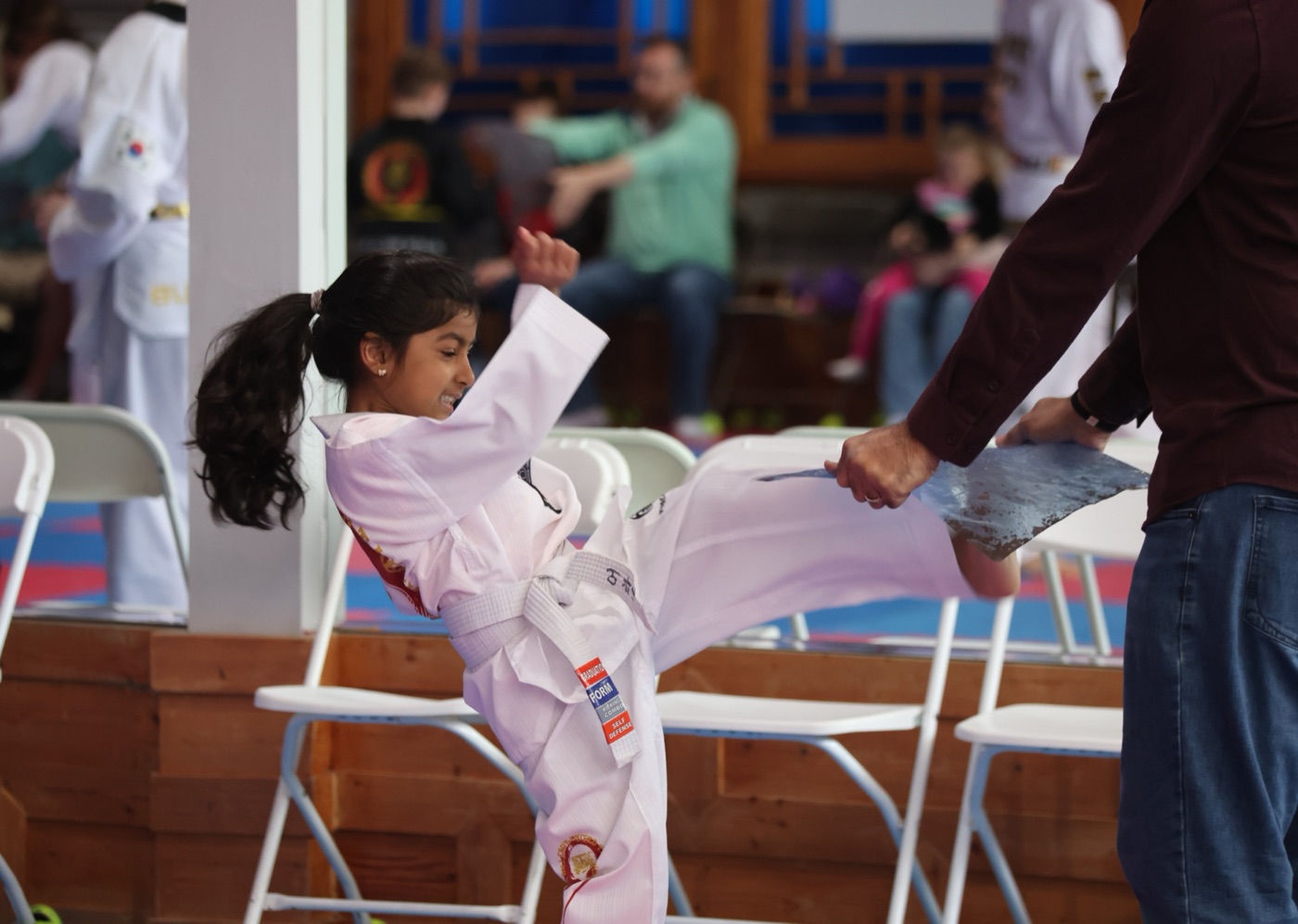
Focus is easy when everything is calm. The real test is whether a child can hold it when their heart is pounding — standing in front of a board they are about to break, or facing a partner in a sparring drill. This is where Taekwondo shines. We teach kids to take a breath, settle their mind, and aim at one target while the nerves are buzzing. Composure under pressure is the highest form of focus there is, and it is a skill that will serve them on every test, stage, and free-throw line of their lives.
And when they miss? When the board does not break on the first try? That is the lesson, not the failure. Our two favorite phrases in the dojang are "Try your best" and "Never give up." A child who learns to refocus after a stumble — to breathe, reset, and go again — has learned something far more valuable than a perfect kick. They have learned that they are the kind of person who gets back up.
A word on respect
You may have noticed respect woven through all five of these. That is not an accident. Focus is how a child pays attention — respect is why they choose to. When a child respects their teacher, they listen. When they respect their training, they show up. When they respect themselves, they refuse to quit. Teach a child respect, and focus follows it home like a loyal friend.
So if you are a parent reading this and wondering whether your child has what it takes — let me put your mind at ease. They do. Every child does. Focus is not a gift handed to the lucky few. It is a skill, and like every skill, it grows when it is practiced in a place that is patient, joyful, and built on respect. That is the only kind of place we know how to build here.
Come see it for yourself. Bring your little tornado. We will be glad to give that energy a direction — and to watch, together, as your child discovers just how much they are capable of.
With respect and a deep bow,
Grand Master Bill Cho
Founder, United Taekwondo Center